The Department
of Medical Sciences (DMSc), Ministry of Public Health of Thailand had conducted
training courses to strengthen health laboratory capacity for ASEAN member
states in scheme of bioengineering control. Therefore, the training course emphasis
on the biosafety and biosecurity measures to ensure that all health
laboratories in ASEAN are ready to cope with the highly pathogenic infections
and life threatening agents.

Dr. Sukhum Karnchanapimai, the Director-General of the Department of
Medical Sciences said that the biosafety and biosecurity are global concerns
since they have been stated both in the International Health Regulation and
Global Health Security Agenda. Thailand is a leading
country for Detect-1 National Laboratory
System of the Global Health Security Agenda which one of the activities in the
package is to provide support for biosafety. As the DMSc is a national
reference laboratory for Thailand, its critical roles are coordinating for
disease surveillance resources, strengthening the role of laboratory
surveillance in the control of emerging and dangerous pathogens and also
establishing for laboratory networking. This year, the project entitled “Biosafety engineering and control for health laboratories in ASEAN” has been implementing by the DMSc with the support from Canada; leading
country for Prevent-3 Biosafety and Biosecurity Action Package,
under the Global Partnership Program. The project aims to build capacity on bioengineers in-country for ASEAN member states.
The Director-General also added that the biological
safety cabinets (BSCs) are the primary engineering control for the minimization
of exposure to potentially infectious materials and is the containment device
essential to protect worker, product and environment. To ensure that the equipment works properly the BSC needs to undergo
maintenance and re-certify regularly. However, a data on BSC certification in
Cambodia, Lao PDR, Vietnam and Thailand showed that only 30 % of the BSC could
pass the certification by US-NSF/ANSI49 standard. Various problems were
identified such as wrong installation, improper certification, users’ lack of
understanding, etc. That’s why the DMSc proposing training courses on BSC
technology and BSC Certifier. An Introduction
course for Biological Safety Cabinet technology: user’s essential workshop was firstly
organized during 4-6 July 2017. The objective of the workshop is to provide a comprehensive
overview of BSCs such as basic
concepts, selection criteria and certification requirements. After finishing
the course in July, participants had to conduct a kind of training to pass on
their knowledge at their workplaces and report their activity in the next
course.

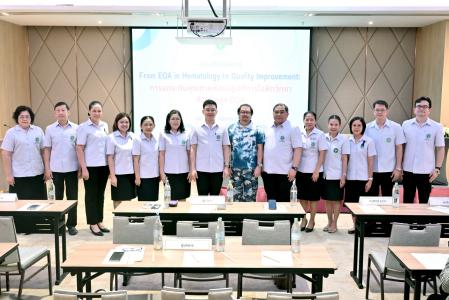
During 14-15
September 2017, the DMSc convened a follow up workshop which was
train-the-trainer program. Participant would come to Thailand to report their
progresses, problem encountered, suggestion, future plan and to share their
ideas on how to customize the training material to fit with each country and
how to sustain a bioengineering control in ASEAN. After completion of this
training course, there were 23 trainers on BSC technology from Cambodia, Indonesia, Lao PDR, Malaysia,
Myanmar, Philippines, Vietnam and Thailand from this program. With the leading
of the DMSc, all ASEAN health laboratories would join together in expanding
this knowledge about comprehensive
overview of BSCs and promote the biosafety and biosecurity concepts throughout
all health laboratories in ASEAN.